
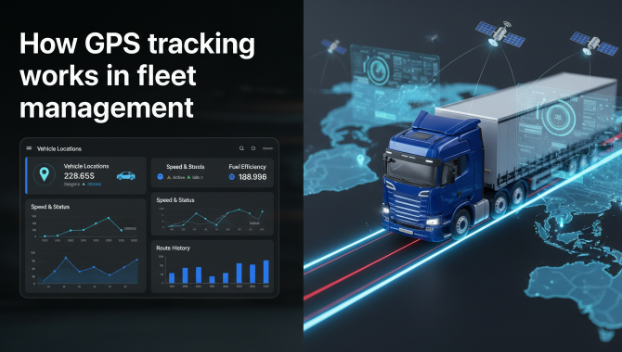
GPS tracking in fleet management started as a location tool. Where is the truck right now. That was the whole value proposition for roughly fifteen years. And for a while, it was enough. Knowing that Truck #8 was on I-40 near Amarillo instead of wherever the driver said he was justified the $30/month subscription.
But location by itself turned out to be a surprisingly low-value data point. Knowing where a truck is doesn’t tell you why it’s burning 18% more fuel than the truck behind it. It doesn’t tell you that the engine coolant is running 4 degrees hotter than last month. It doesn’t tell you that the driver’s braking pattern has changed in a way that’s eating through brake pads twice as fast as the fleet average.
The technology behind GPS fleet tracking hasn’t changed all that much at the hardware level. What changed is everything that sits on top of it.
The basic mechanics, briefly
A GPS tracking device receives signals from at least four of the 31 satellites in the U.S. Global Positioning System constellation. By calculating the time each signal takes to arrive, the device triangulates its position to within a few meters. Modern fleet systems also pull from GLONASS (Russian), Galileo (European), and BeiDou (Chinese) satellite systems, which improves accuracy in dense urban canyons and remote areas where a single constellation might have poor coverage.
That position data gets transmitted via cellular network (4G LTE in most current devices, increasingly 5G) to a cloud platform where it’s processed, stored, and displayed. The transmission interval varies. Some systems ping every 10 seconds for real-time tracking. Others report every 60-120 seconds to conserve battery and data costs. The right interval depends on whether you’re tracking a long-haul truck on a highway (60-second updates are fine) or a delivery van making 30 stops in a city (you need tighter intervals to see the stop-by-stop pattern).
That’s the tracking part. It’s been essentially the same since the early 2000s. Where the technology diverges into something actually useful for fleet management is what gets layered on top of the location signal.
When GPS connects to the vehicle’s brain
The shift that turned GPS from a map dot into a management tool happened when tracking devices started connecting to the vehicle’s onboard diagnostic port. Through the OBD-II port (standard on every vehicle since 1996) or the CAN bus on heavier trucks, the GPS device can read engine data in real time.
Engine RPM, coolant temperature, oil pressure, fuel injection timing, battery voltage, transmission behavior, exhaust gas temperatures, diagnostic trouble codes. All of this data flows alongside the location signal to the cloud platform. Now you don’t just know where Truck #8 is. You know how it’s performing, how it’s being driven, and whether something mechanical is starting to drift.
This is what modern fleet location tracking actually does. It combines position data with vehicle health, driver behavior, and fuel consumption into a single stream. A fleet manager looking at Truck #8 on the map can simultaneously see that it’s been idling for 23 minutes, that the driver hard-braked twice in the last hour, that fuel efficiency on today’s route is 11% below the truck’s own baseline, and that coolant temperature has been trending slightly high for the past week.
That’s not GPS tracking. That’s vehicle intelligence delivered through a GPS-connected platform.
What fleet managers actually use the data for
Once you’re collecting location plus vehicle telemetry plus driver behavior, the practical applications sort themselves into a few categories.
Knowing where the truck is still matters, but for different reasons than it used to. Real-time location feeds into ETA calculations, proof-of-delivery timestamps, and customer-facing visibility. When a shipper can see that their load is 45 minutes away instead of calling the driver, that’s a service upgrade. Geofencing creates virtual boundaries around customer sites, depots, fuel stations, and restricted areas. When a truck enters or exits a geofence, the system logs it automatically. This replaces manual check-in calls and creates a timestamped record that’s useful for billing disputes, detention time claims, and compliance documentation.
Fuel monitoring is where GPS tracking pays for itself fastest. Over 63% of fleets now use GPS and real-time monitoring to manage operations, according to industry surveys. By tying GPS position to fuel level data and engine diagnostics, fleet managers can track consumption per truck, per route, per driver. They can detect anomalies like sudden fuel drops (possible theft), excessive idle-time fuel burn, and trucks that consistently underperform on mileage. GPS-connected fuel monitoring systems that cross-reference fuel card transactions against actual tank level changes catch discrepancies that manual reconciliation misses for months.
Driver behavior scoring uses accelerometer data alongside GPS speed readings and engine data to identify hard braking events, rapid acceleration, speeding, harsh cornering, and excessive idling. Each event gets tagged with a GPS location and timestamp, so coaching conversations can reference specifics. Not “you brake too hard” but “you hard-braked at the Route 9 intersection three times this week, and here’s what that costs in brake wear and fuel.”
Maintenance forecasting is the layer that’s matured most in the past few years. By continuously monitoring engine and component data alongside location and route information, platforms can identify when a vehicle’s behavior starts deviating from its own baseline. A truck that’s burning slightly more fuel than its historical average on the same route might have a developing injector issue. A truck whose coolant temperature is creeping up might be heading toward a cooling system failure. GPS data provides the route and operating context. Engine data provides the health signal. Together, they enable condition-based maintenance that catches problems weeks before they become breakdowns.
The gap between tracking and intelligence
This is the part most fleet managers don’t think about until they’ve had a GPS system for two years and realized they’re only using 10% of its capability.
Basic GPS tracking generates data. A lot of data. A 50-truck fleet producing location pings every 30 seconds generates millions of data points per month. Add engine telemetry and you’re looking at billions of sensor readings across a fleet over a year.
The question is whether anyone’s doing anything with it beyond looking at a map and running a weekly mileage report. Most fleets aren’t. The data piles up in a server somewhere, and the fleet manager is still making decisions the same way they did before the GPS was installed.
The platforms that deliver actual ROI are the ones that process this data automatically and surface exceptions, the specific trucks, drivers, routes, or events that need attention. Instead of a dashboard showing 50 green dots, you get a notification that Truck #22 has been idling 38% more than its fleet average this week, and that Truck #15’s fuel efficiency dropped 9% compared to last month on the same lane.
When GPS tracking integrates with AI and IoT to create a unified intelligence layer, the fleet manager’s job shifts from monitoring everything to responding to what matters. That’s the difference between a $30/month tracking subscription and a fleet management platform that actually changes outcomes.
The ROI question everyone asks
Verizon Connect’s 2024 fleet technology trends report found that 41% of GPS tracking users saw positive ROI in less than a year. Fuel savings alone, from idle reduction, driver coaching, and theft prevention, typically cover the subscription cost within 3-6 months for fleets over 20 vehicles.
But the bigger returns come from the less visible categories. Reduced unplanned downtime from predictive maintenance. Lower insurance premiums from telematics-verified safety programs. Fewer customer complaints from better ETA accuracy. Reduced detention charges from automated geofence timestamps. These don’t show up on a single line item but compound into substantial annual savings.
The fleets that get the most value from GPS tracking are the ones that treat it as an operating system for decisions, not a surveillance tool for drivers. The data is the same. What you do with it determines whether you’ve bought a map or a management platform.